
What Do Nano & Microbots Really Look Like? Part 1


Well, probably not like this…
I’m a lot more stringent than I used to be when it comes to judging moving objects in blood and other liquids. When I first started looking at things under a microscope, I assumed that if something had colors, or moved funny, it was probably manmade technology. But, something never felt quite right about that. How could I be sure?
To improve my discernment, I took a class in Live Blood Analysis from Neogenesis Systems. I wanted to find out which objects were considered normal in blood, and which were not. I learned a lot from the class, but later found out that not everyone in the Live Blood Analysis field agrees on the definition of every object.
To make things simple, I decided to go with what what I’d been taught in the class, whenever possible. That seemed to help in the beginning but, then, the lines between what was biological and what was technological began to blur faster than I, or almost anyone, could keep up.
Nanotechnology developers, who as a group seem to move at lightning speed, are increasingly mixing technology with natural lifeforms like: bacteria, worms, and other products of nature; hijacking red blood cells; creating synthetic ones, and utilizing patterns and movements observed in nature, to create tiny, hybrid machines. The feeling one gets in a research envirnoment like this deserves a new adjective. How about: ‘Mazespun,’ ‘Logic-hacked,’ or ‘Begobbled’? What’s a budding researcher to do?
I once spent 13 hours studying a raw milk sample. I thought I was seeing spherical nanocarriers at first, but they moved funny and seemed abnormally small compared to those I typically found in commercial foods. They also looked beautiful somehow. They carried a feeling that can best be described as a combination of: magic, energy and dance.
If they had been nanocarriers, a local dairy producer’s business could have been compromised. Luckily, that isn’t what they were. At the end of the day, I found a YouTube video that showed natural bacteria moving in raw milk. They looked exactly like what I was seeing.
What I’ve been doing lately is looking at pictures and videos, and reading articles to see if I can find things that match, or look almost identical to, things I am seeing under the microscope. Then, I check their size and use, and try to determine if, and/or how, they could have gotten into what I’m looking at.
Are they used in what I am looking at, whether it be medicine or agriculture?
If I’ve taken a sample of capillary blood, I look into what I think I might be seeing to determine whether that sort of object could get through human capillaries, given their size.
If not, I look at how such technology typically forms, and consider whether their components could have self-assembled on my slide at a later stage. When I don’t see a structure, initially, and can only discern it after several minutes or hours, self-assembly of micro tech. becomes a more viable possibility. But, evaporation and drying processes, as well as initial contamination from whatever may have been on the slide, still need to be considered.
I have a pet peeve I’ve been sitting on for a couple of years now that is annoying me a bit too much to stay silent any longer. Here it is:
I can’t stand it when researchers point to all, or most, of the moving objects in a sample and confidently declare that the objects are nanobots without explaining why. (Not many researchers do this, but some do.) Maybe some of those dots they’re looking at are nanobots. But, there are a lot of other bright objects that move in samples that aren’t.
According to Gunther Enderlein’s Pleomorphic Growth hypothesis, (which, admittedly, not everyone agrees with), lots of moving objects appear in blood naturally as it ages, no tech. required. According to Enderlein, these objects participate in the process of decomposition - what happens to bodies after death. Many of them are round and some of them move.
White dots that appear in blood as it ages could, for example, be ‘symprotits,’ (particles that can develop in imbalanced blood as it ages). Other moving white dots that appear in blood naturally are known as: ‘chylomicrons’ (lipoproteins produced by the body after a meal).
There are a number of other objects that can appear in blood, and other liquids, that don’t necessarily represent technology. It depends on what you’re looking at; what it contains, its age, condition and other factors.
Video #1 - Aged, Unvaccinated Blood Sample.
Some of the smaller moving particles seen above may be symprotits or chylomicrons. The small donut-shaped object just above the center, is probably a sporoid symprotit - another object that falls under the Pleomorphic Growth hypothesis. Some moving objects see above could be natural bacteria. Aside from the moving red and green particle, with a hint of yellow, in the far upper righthand corner, I don’t see anything in the video I’d be tempted to classify as a nano or microbot. (We’ll get to that red and green object shortly. As it turns out, that one does meet some robot requirements.)
Because most of the suspicious, moving, dot-like shapes I’ve seen in blood are a combination of red and green, I began looking for information on red and green nanomaterials. In 2023, I typed: ‘red and green nanobots’ into my search browser, but nothing came up. A couple years later, in late 2025, several references came up when I substituted the word: ‘microbots’ for ‘nanobots.’ Apparently, more than one type of microbot fits that description.
Some Types of Red and Green Microbots
Algae-based microbots have been developed for various medical purposes, and some have red and green bits. The first article I came across on this topic described a biohybrid micro robot that consisted of live algae, combined with “nanoparticles coated with red blood cell membranes” The red blood cell membranes are used to trick the immune system into thinking the microbot is natural, so it doesn’t get attacked (Li, Zhengxing “Microrobots made of algae carry chemo directly to lung tumors, improving cancer treatment” THE CONVERATION 12 June 2024.)
This particular type of micro robot doesn’t strike me as the best candidate for what we’re seeing in Video #1, because the colors aren’t separated as well as they are in other kinds of red and green microbots and, a video, included in the article noted above, shows them as entirely red in darkfield.
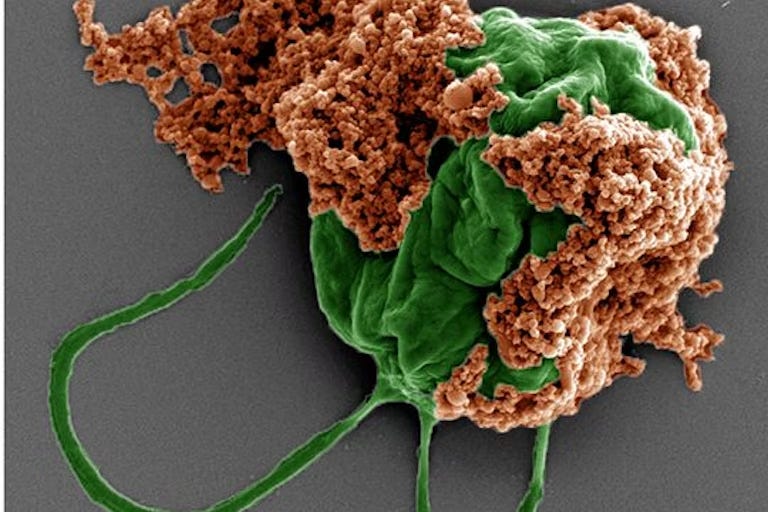
“Part algae, part red blood cell, these microrobots can travel to hard-to-reach tumors deep in the lungs. From Zhang et al., Sci. Adv. 10, eadn6157 (2024), CC BY-NC” (See complete reference for diagram in Reference List down below).
The video mentioned previously, explains that the hybrid algae micro robots killed bacteria in labratory mice. Later in the video, the presenter explains that another researcher successfully loaded these micro robots into Aspirin. (Yikes! That’s fuel for thought.) Here’s a link to the video: (“Algae robots delivering drugs in the body dramatically improve survival rates” YouTube KPBS Public Media Posted: Sept 26, 2022 at: https://www.youtube.com/watch?v=OuOr6Dj1Wsw Accessed: November 7, 2025)
Later, I found an article on hybrid algae that included pictures showing green and red parts that were more clearly separated: (Oncay, Yasa, et. al “Microalga-Powered Microswimmers toward Active Cargo Delivery,” 2018) This seemed like a better candidate than the last one, for the moving red and green objects I’d been seeing.
Other possible candidates are 3D printed red and green microscopic fish.
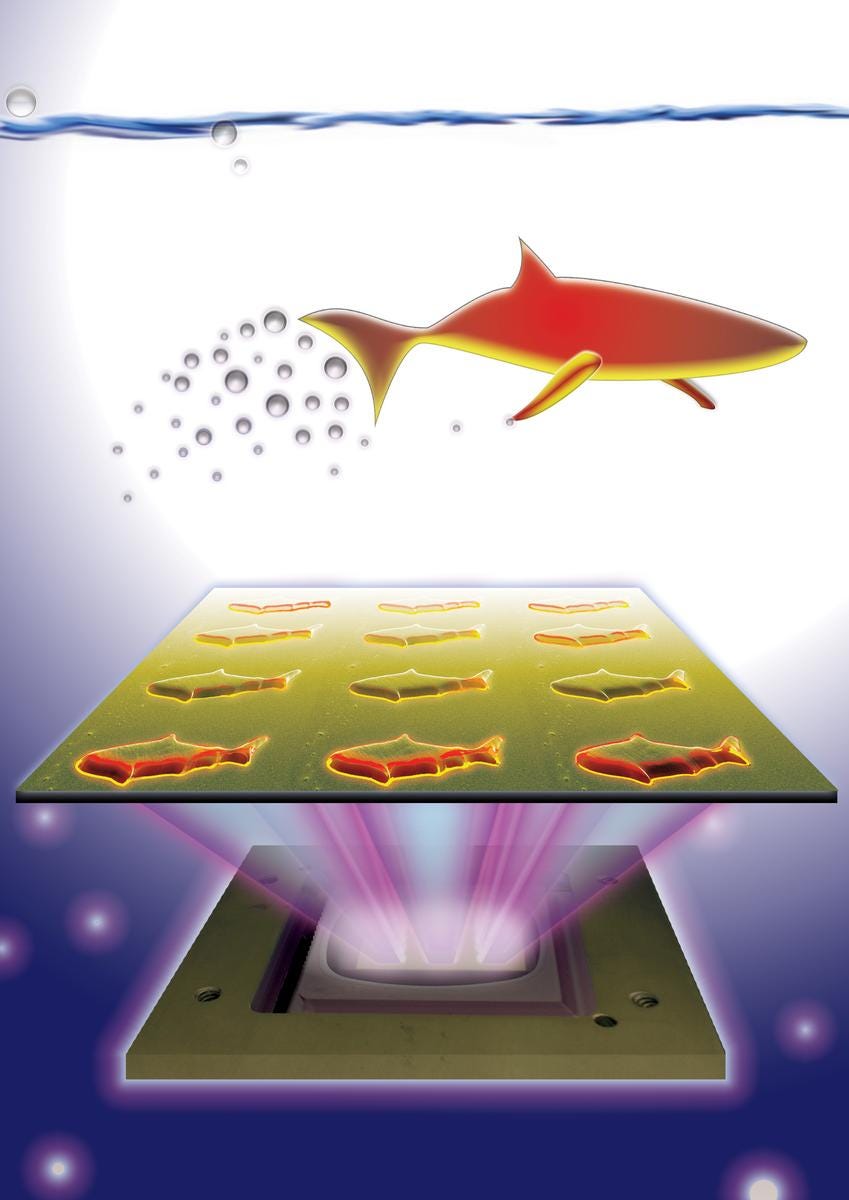
“3D-printed microfish contain functional nanoparticles that enable them to be self-propelled, chemically powered and magnetically steered. The microfish are also capable of removing and sensing toxins. Image credit: J. Warner, UC San Diego Jacobs School of Engineering.”
The above image and accompanying text are from a News Release, entitled: “These microscopic fish are 3D-printed to do more than swim: Researchers demonstrate a novel method to build microscopic robots with complex shapes and functionalities” UC San Diego Jacobs School of Engineering (August 25, 2015) at: https://jacobsschool.ucsd.edu/news/release/1797?id=1797 One of the possible uses for these microfish envisioned in 2015 was to transport drugs through fluids.
Of course, the objects mentioned above may have little, or no relationship, to the red and green moving dots I´ve been seeing in blood and other fluids. But, they do represent possibilities that could be explored further. Steps to take could involve checking to see if any of these creations have ever been used in whatever fluid I found them in; their size, general purpose, etc.
While searching for images of nano and microbots online, I’ve come across many images that resemble other things I’ve seen in fluids overtime. Here are some examples:
The following image comes from: Palagi, S., Fischer, P. “Bioinspired microrobots” Nat Rev Mater 3, 113–124 (2018) https://doi.org/10.1038/s41578-018-0016-9 . The image heading is as follows:
Fig. 1: Propulsion of helical microstructures
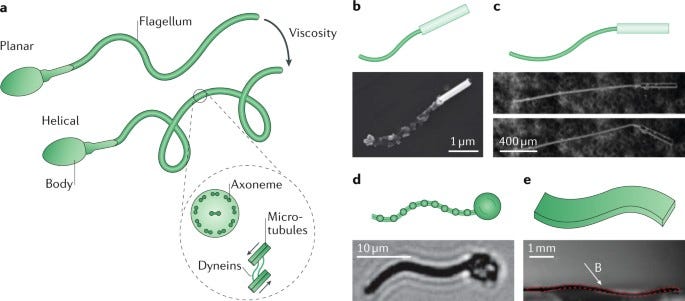
(See full reference in Reference List below.)
I’ve often found objects that look similar to those seen above in fluids (in the sense that they contain a thin wire or filament connected to an end with a notably different shape).
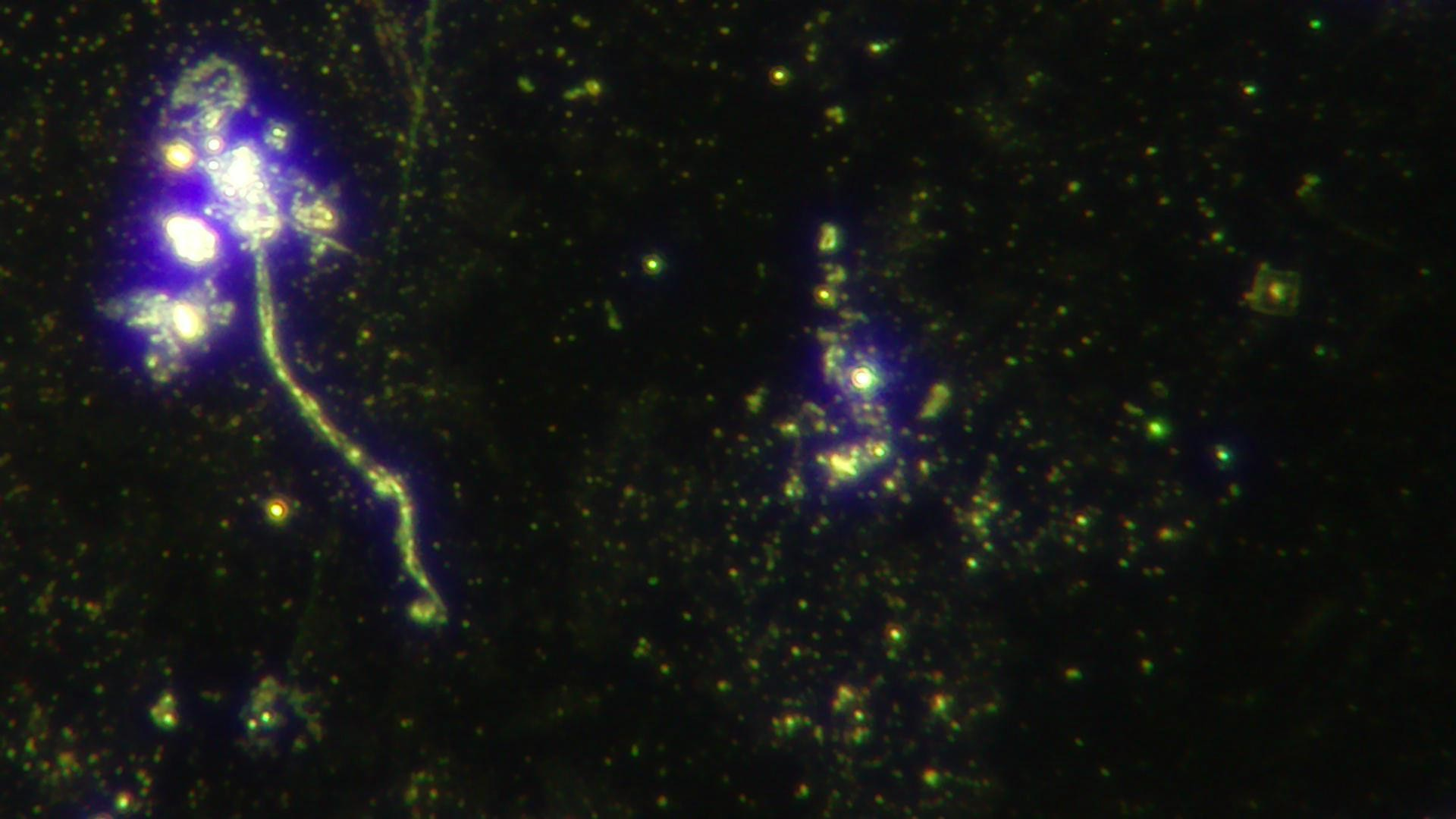
Picture 1 (above): Fresh Juice from a Commercial Tomato. A wire or filament attached to a rectangular is seen on the left.
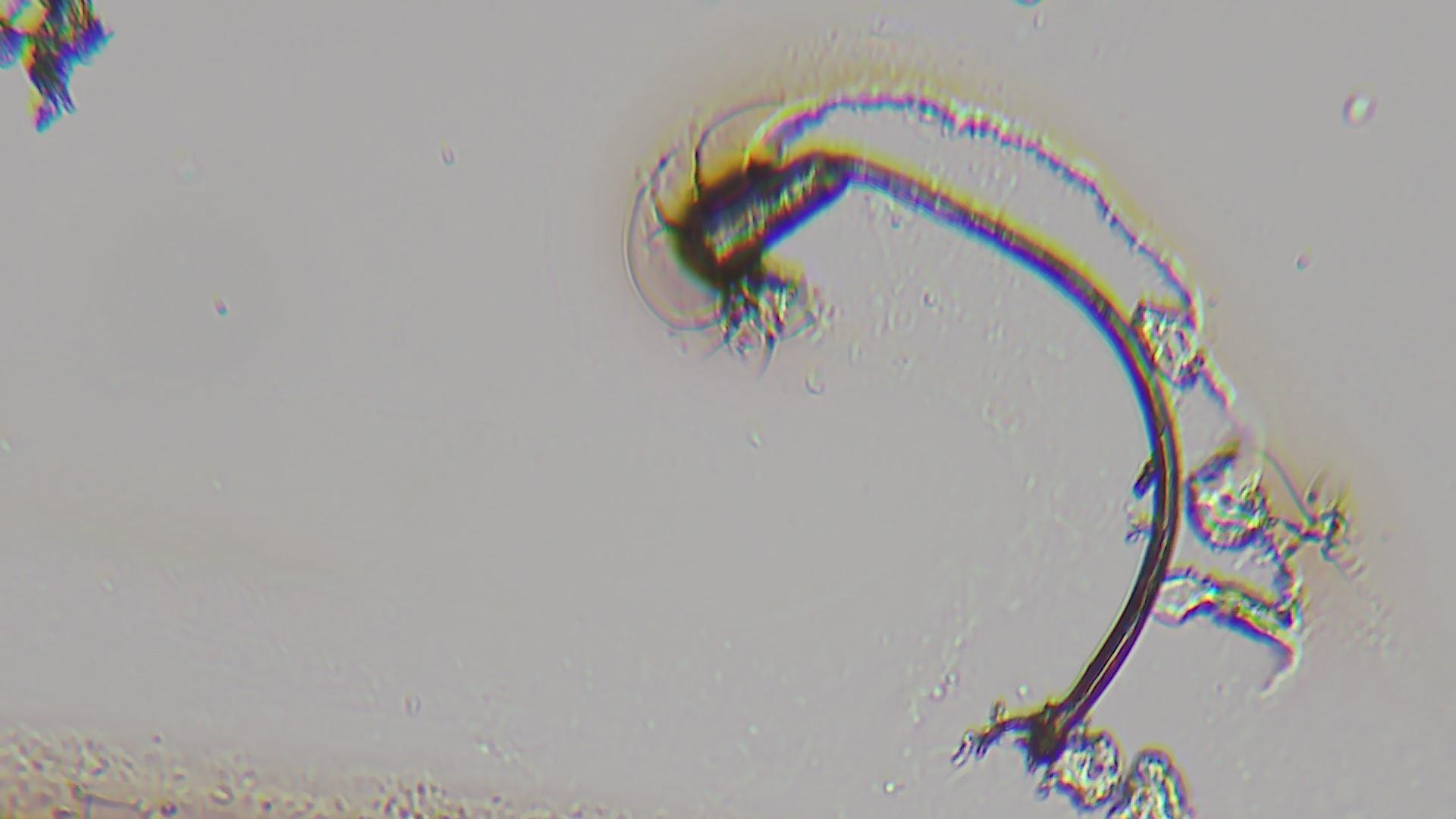
Picture 2 (above): Blood and Colloidal Gold Mix. A Strand-like Object with an Oddly-Shaped End.
The following picture isn’t necessarily evidence of technology, but it could be.
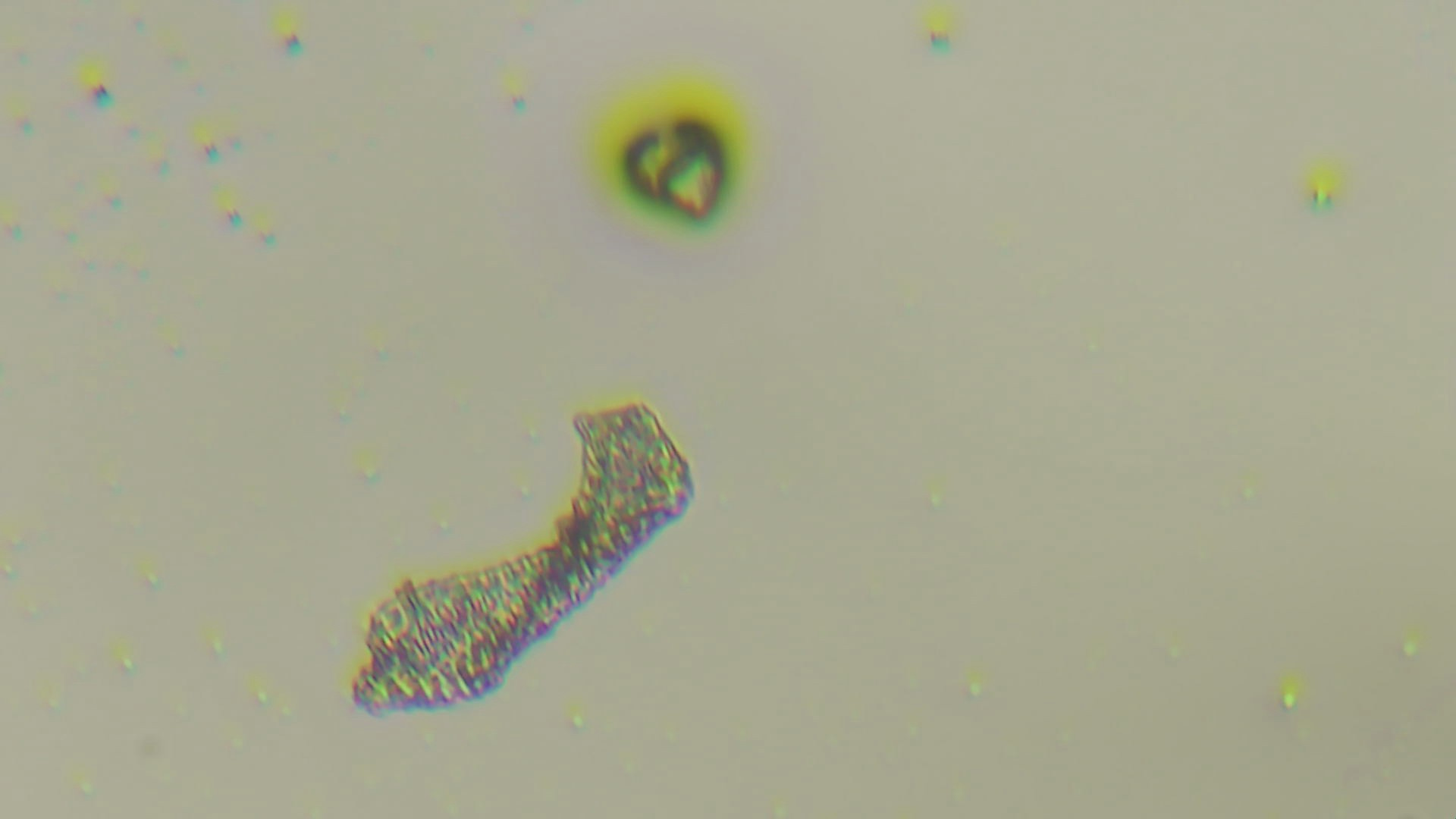
Picture 3 (above): iHerQles sample. (iHerQles is a popular supplement marketed as part of a Multilevel Marketing (MLM) effort). The object with the twist in the bottom portion of the screen reminds me a little of the object seen in the image below.
The following image, which shows a soft robot composed of numerous microbots, was taken from: Maslen, Charlie “Microrobots crawl, slide, and connect to form larger 3D structures” Intelligent Systems and Robotics Posted on: Advanced Science News 17 July 2023.
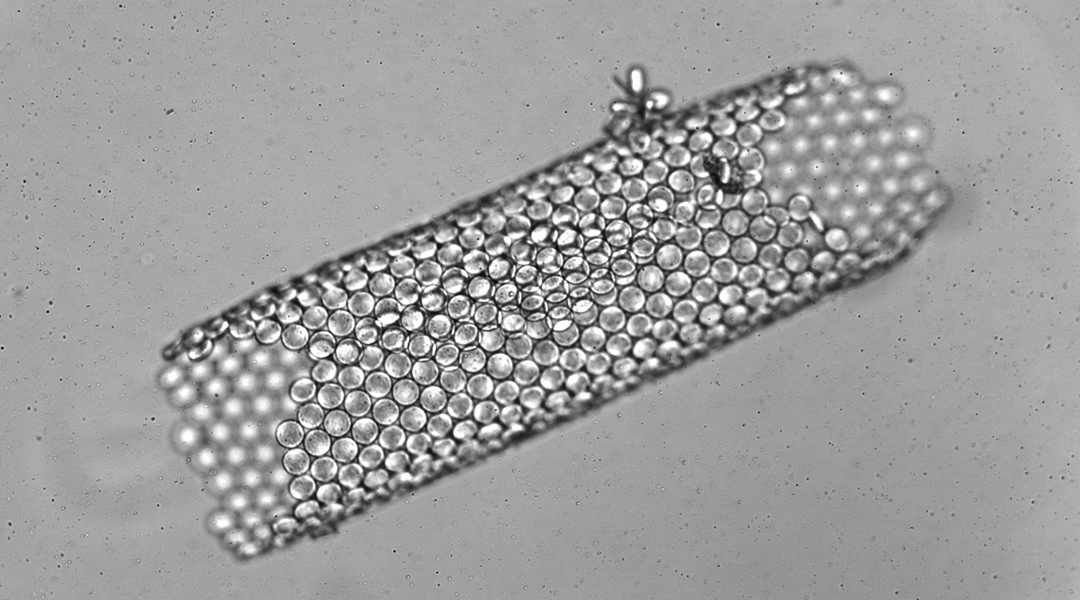
The article referenced above refers to a study in which researchers linked microbots together in a substance consisting of hydrogel. An article on the study, (Kropacek, Jindrich, et al. “Hydrogel Microrobots Self-Assembled into Ordered Structures with Programmable Actuation” WILEY ADVANCED Advanced Intelligent Systems Vol 5, Issue 9 September 2023, First Published: 08 July 2023), describes how these microbot collections can move and change shape, by folding or bending.
Of course, the similarity doesn’t prove anything conclusively about the object in Picture 3, but it opens up some avenues for research.
Images and diagrams of nanobots that don’t resemble science fiction-style cartoons are a bit harder to come by than images of microbots. Sometimes, the two terms are used interchangably. To be considered ‘nano’ in scale, a nanomaterial must have one dimension that ranges from 1-100 nanometers in size, however other dimensions can be larger. This, and the fact that quality darkfield microscopes can resolve objects that as small as 40 nanometers in size, can make differientiating nanobots from microbots difficult at times. No matter how many images I look at, it’s likely that some things I see are destined to remain a mystery.
Reference List of Sources not Previously Listed in Full
Kropacek, Jindrich, et al. ¨Hydrogel Microrobots Self-Assembled into Ordered Structures with Programmable Actuation¨ WILEY ADVANCED Advanced Intelligent Systems Vol 5, Issue 9 September 2023, First Published: 08 July 2023. https://advanced.onlinelibrary.wiley.com/doi/10.1002/aisy.202300096
Li, Zhengching ¨Microrobots made of algae carry chemo directly to lung tumors, improving cancer treatment¨ THE CONVERSATION Published June 12, 2024 https://theconversation.com/microrobots-made-of-algae-carry-chemo-directly-to-lung-tumors-improving-cancer-treatment-232136
Maslen, Charlie. ¨Microrobots crawl, slide, and connect to form larger 3D structures¨ Intelligent Systems and Robotics Posted on: Advanced Science News 17 July 2023. https://www.advancedsciencenews.com/microrobots-crawl-slide-and-connect-to-form-larger-3d-structures/
Oncay, Yasa, et al. ¨Microalga-Powered Microswimmers toward Active Cargo Delivery¨ScienceAdvances First Published:: 25 September 2018, Advanced Materials, Vol. 30, Issue 45, 8 November 2018. https://advanced.onlinelibrary.wiley.com/doi/10.1002/adma.201804130
Palagi, Stephano and Peer Fischer. ¨Bioinspired microbots¨ Nature Reviews Materials Volume 3, pages 113–124, Published: 10 May 2018, Figure 1 https://www.nature.com/articles/s41578-018-0016-9
Zhang, Fangyu, et al ¨Biohybrid microrobots locally and actively deliver drug-loaded nanoparticles to inhibit the progression of lung metastasis¨ Science Advances, Vol. 10, Issue 24, 12 Jun 2024 https://www.science.org/doi/10.1126/sciadv.adn6157
Thanks for reading. Stay tuned for more,
Daisy
https://pubs.acs.org/doi/10.1021/acsnano.5c03911?ref=recommended
Thank you, Daisy- I appreciate your content and this candid article that highlights your responsibility and humility. Nobody has all the answers for this stuff, and not everyone is out there investigating and researching like you. Some people are just going to leave crappy comments, no matter what you do! Keep up the good fight!
Good article, thanx. But, ..why not write an article about specific claims that Dr. Ana makes (incl. analyzing the microscopic pictures she presents) and debate about it.. what else could it be ? Be specific. Because I have been wondering about all of this, too.. Or have a talk with her directly and debate... If we wanna be scienticif about this. I am interested.